

AI has become a key development in CRM systems, and most vendors promote it for sales automation, forecasting, and productivity gains. However, many AI features don’t deliver clear business value and often operate as separate tools.
In SAP Sales and Service Cloud, AI is built into everyday sales tasks. It helps with lead qualification, preparing for customer meetings, revenue forecasting, and more, while keeping customer data accurate and secure.
This article covers 12 AI features and intelligence capabilities in SAP Sales and Service Cloud CRM that help sales teams work more efficiently and make better business decisions.
How AI works across SAP Sales and Service Cloud
SAP Sales Cloud and SAP Service Cloud include a growing range of AI capabilities. These range from predictive AI for forecasting and prioritizing, to generative AI for creating and summarizing content, conversational AI with Joule, intelligent automation for workflows, and new emerging agentic AI that can handle more complex tasks.
| AI category | SAP Sales Cloud | SAP Service Cloud |
| Predictive & ML based AI | Lead and opportunity prioritization; forecasting and pipeline intelligence | Case prioritization, case type determination, similar case recommendation, and service-demand insights |
| Generative AI | Draft customer communications; summarize interactions | Summarize cases; draft customer responses |
| Conversational AI | Ask questions and retrieve sales information using Joule or supported assistants | Get contextual help and access service information using Joule or supported assistants |
| Intelligent automation | Reduce manual updates and streamline sales processes | Case routing, duplicate detection, and workflow automation |
| Agentic AI* | Assist with multi-step selling tasks and follow-ups | Assist with case investigation, knowledge retrieval, and resolution workflows |
* Agentic AI is an emerging area within SAP CX. Some of its capabilities are included in the roadmap and will be rolled out in phases or via the Early Adopter Care programme.
SAP continues to add more tools to its portfolio of AI capabilities. Our team at ACBaltica has picked out the most notable features for you.
1. AI for smarter sales decisions and revenue growth
Capability 1: Lead & Opportunity scoring
Sales managers often handle many potential customers and deals at once, making it hard to set priorities. This can lead to missed opportunities.
To address this challenge, SAP Sales Cloud uses Lead&Opportunity scoring to improve visibility.
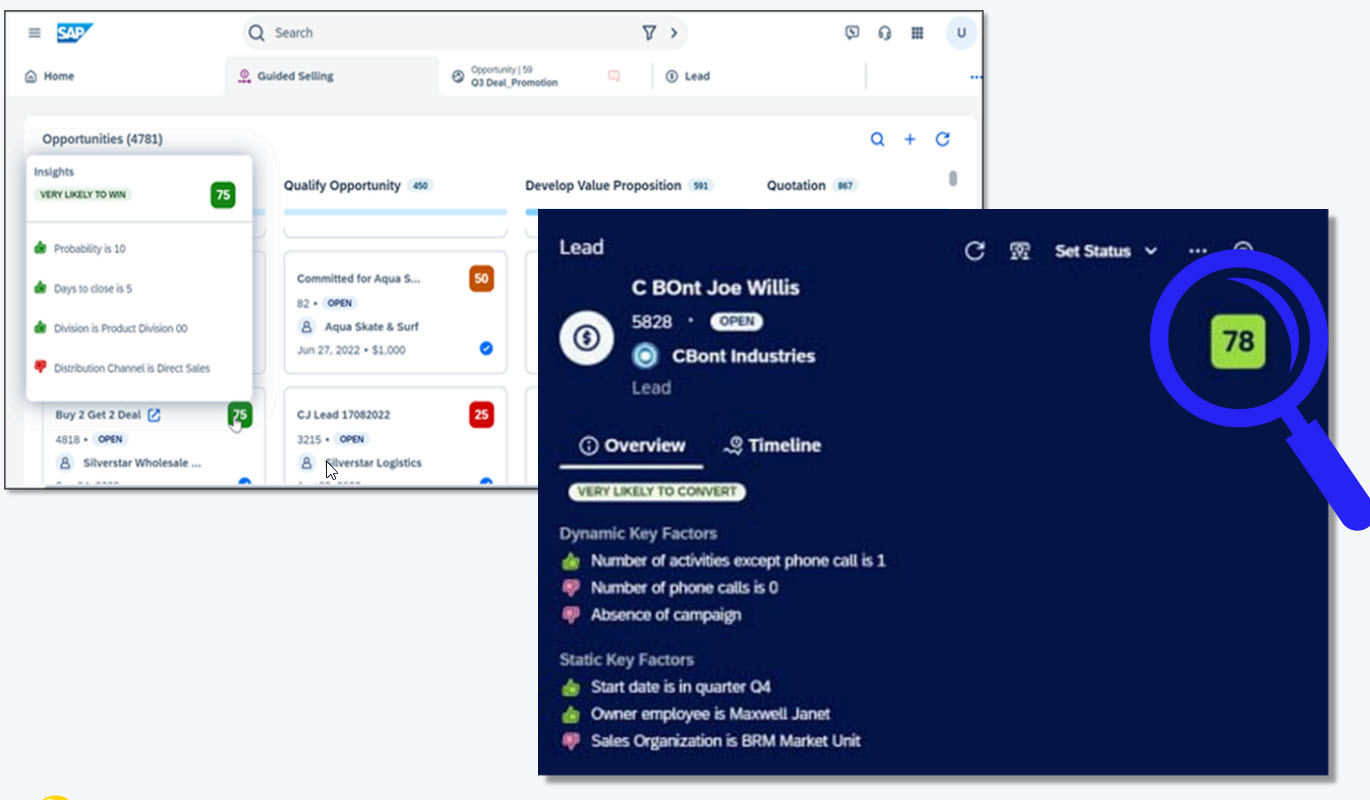
Lead and Opportunity Scoring uses machine learning to predict the likelihood that a lead will become an opportunity and that the deal will close successfully. SAP can train the model on each organization’s historical CRM data, ensuring predictions reflect the company’s unique sales process (not general industry assumptions).
Depending on the available data, the model can evaluate factors such as:
- Lead source (website, campaign, partner, event, etc.)
- Customer segment and geography
- Sales organization structure and sales channel
- Previous interactions
- Historical conversion patterns
- Custom CRM fields defined by the organization
- Current sales phase and opportunity status
- Opportunity age and sales cycle progression
- Changes to the expected closing date
- Deal value adjustments over time
- Sales activities and customer engagement
- Historical performance of similar opportunities
Following that, every opportunity and each lead receives a unique win score.
Instead of manually analyzing each lead and opportunity, organizations receive a reliable assessment of conversion probability.
With this feature, you focus on prospects with the highest probability.
Business value
- Prioritize leads and opportunities based on their likelihood of conversion or success
- Focus sales resources on the most relevant opportunities
- Identify potential risks earlier in the sales cycle
Capability 2: Sales Forecasting and Pipeline Intelligence
Sales Forecasting in SAP Sales Cloud helps you understand how much a company is likely to sell over a specific period.
SAP generates a forecast based on opportunity data and expected revenue. A sales representative can mark promising opportunities as “Publish to Forecast” so that their total is included in the forecast. A manager reviews it and, if the numbers appear incorrect, can request a revision. Afterward, the manager can combine their team’s forecasts into an aggregate forecast. AI adds an additional intelligence layer to forecasting by using machine-learning-based Opportunity Scores to assess pipeline health and support predictive forecast calculations.
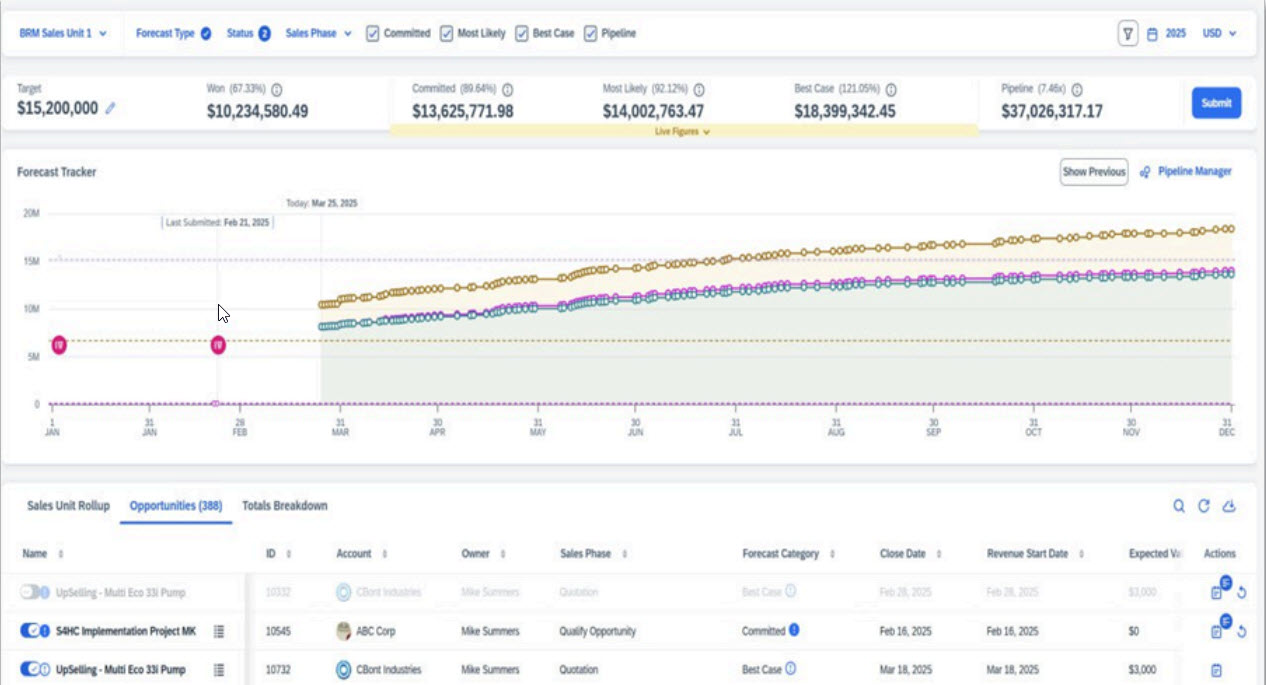
The forecast can be updated throughout the sales cycle. If opportunity status changes, the forecast owner can submit a new version of the forecast. SAP also allows you to compare the forecast with sales targets and pipeline performance in real time.
Business value
- Standardize the sales forecasting process across the organization.
- Improve forecast accuracy using up-to-date opportunity and pipeline data.
- Enable collaborative forecasting between sales representatives and managers.
- Compare forecasts with sales targets and pipeline performance.
- Support better planning and resource allocation.
Capability 3: Account synopsis
Preparing for a customer meeting often requires sales representatives to gather information from multiple sources, including CRM records, company websites, and public business information.
SAP Sales Cloud simplifies this process with Account Synopsis, an AI capability that automatically generates a concise summary of a customer account.
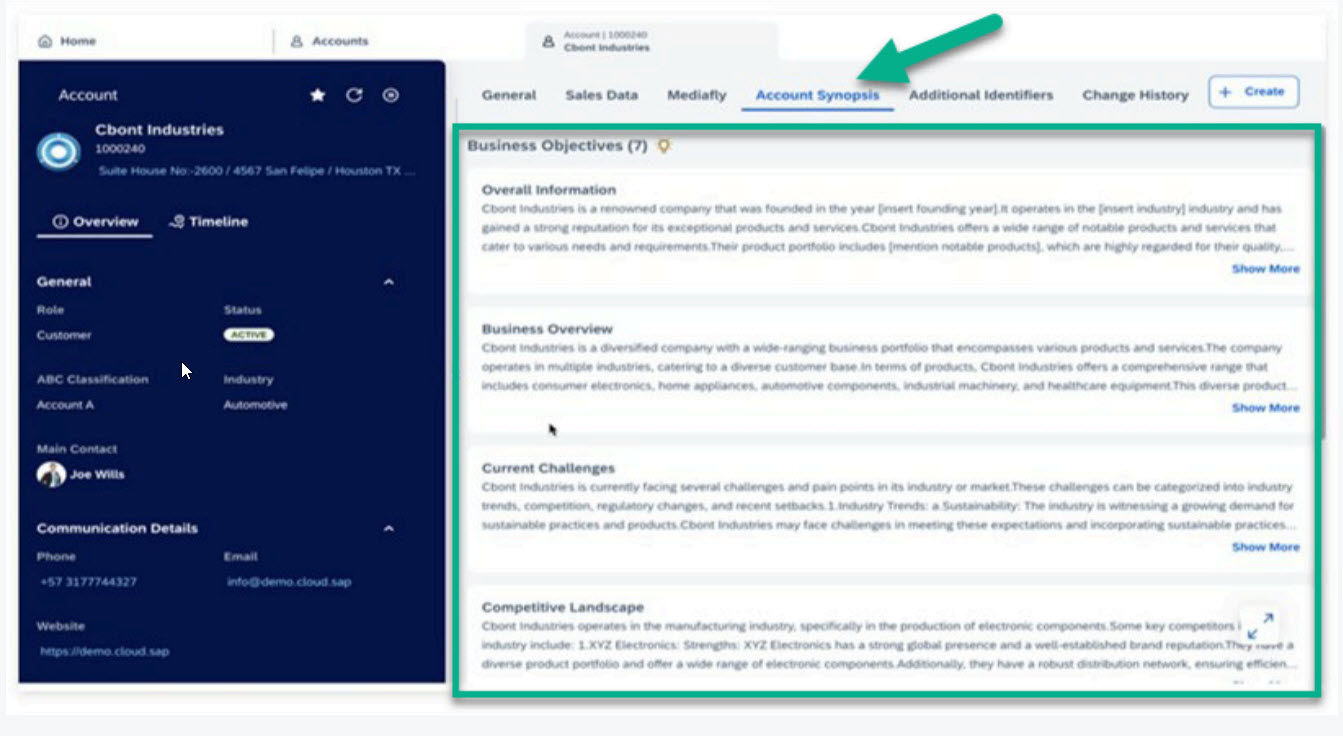
Depending on the available information, the summary can include the company’s profile, products and services, industry position, customer base, competitive landscape, business strategy, and other relevant background information. Instead of spending time searching across different sources, sales representatives receive a structured overview directly within the CRM.
Business value
- Reduce time spent researching customers before meetings
- Give sales representatives a quick overview of each account
- Help new sales team members get up to speed faster
- Enable more informed and personalized customer conversations
- Improve meeting preparation without leaving the CRM
Capability 4: AI product recommendations
AI Product Recommendations in SAP Sales Cloud help salespeople identify other products worth offering to customers.
In SAP Sales Cloud Version 2, recommendations can utilize machine learning. The model is trained on historical opportunity and sales quote data and uses it to generate recommendations. It supports upselling and cross-selling.
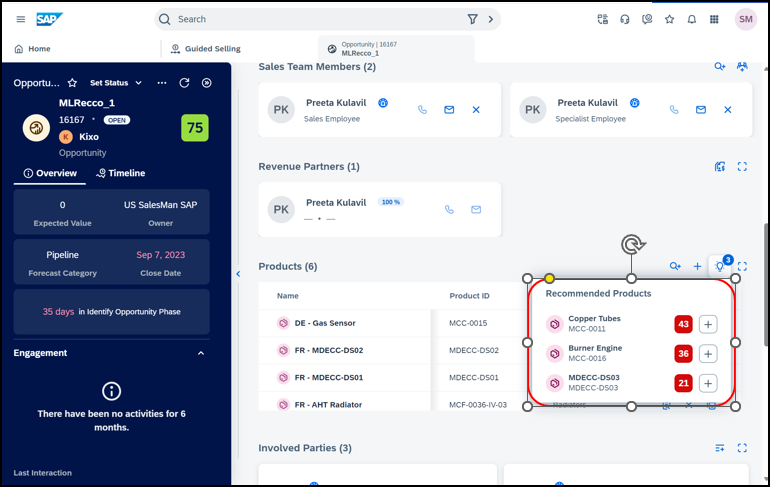
This means salespeople don’t have to manually search the catalog for similar products every time. Within an opportunity, the system can display a list of Product Recommendations, from which the salesperson selects suitable products and adds them to the deal.
Business value
- Identify cross-sell and upsell opportunities faster
- Reduce time spent searching product catalogs
- Gain more relevant product recommendations
- Improve sales efficiency
Capability 5: Next best action
SAP Sales Cloud helps sales representatives identify the next logical action based on the opportunity stage, customer engagement, and the company’s sales process.
It delivers recommendations through Guided Selling, combining real-time CRM context, configured Playbooks, and intelligent signals to suggest relevant next steps. AI-enhanced signals, such as engagement and relationship insights, can make these recommendations more contextual and relevant.
Depending on the opportunity, the system can recommend actions such as:
- Schedule a follow-up meeting
- Contact the customer
- Send a quotation
- Complete required sales activities
- Move the opportunity to the next sales stage
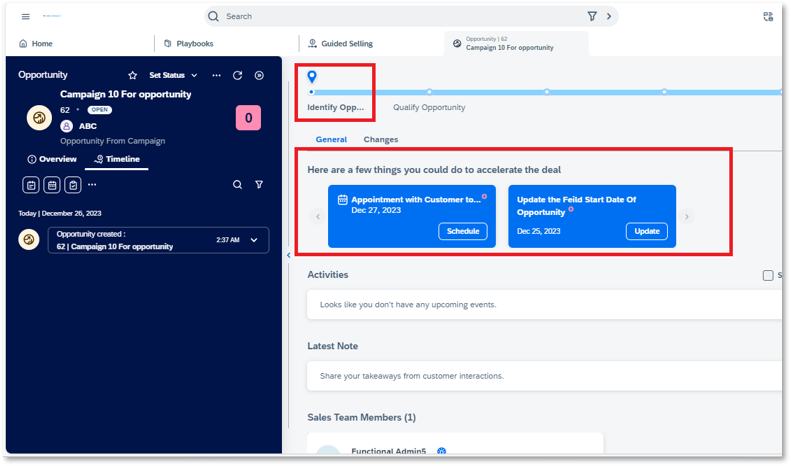
As opportunities progress, recommendations are updated automatically to reflect the current sales context.
Business value
- Guide sales representatives through the next recommended action
- Reduce missed activities during the sales cycle
- Help accelerate opportunity progression
- Improve sales process consistency and adoption of best practices
2. AI for sales and service productivity
Capability 6: AI-powered Email Drafter
SAP Email Drafter supports both sales and service scenarios, generating context-aware responses based on information available in SAP.
In Sales Cloud, it can create drafts for Leads, Opportunities, Sales Quotes, and Sales Orders using relevant CRM data. Users can control the message’s purpose, tone, style, and length.
When creating an email, SAP considers:
- previous email correspondence
- opportunity or lead data
- product information
- deal status
- the selected email objective (prompt)
For service teams, Email Drafter works from the Case context, helping generate responses such as status updates, SLA information, or answers referencing relevant knowledge articles.
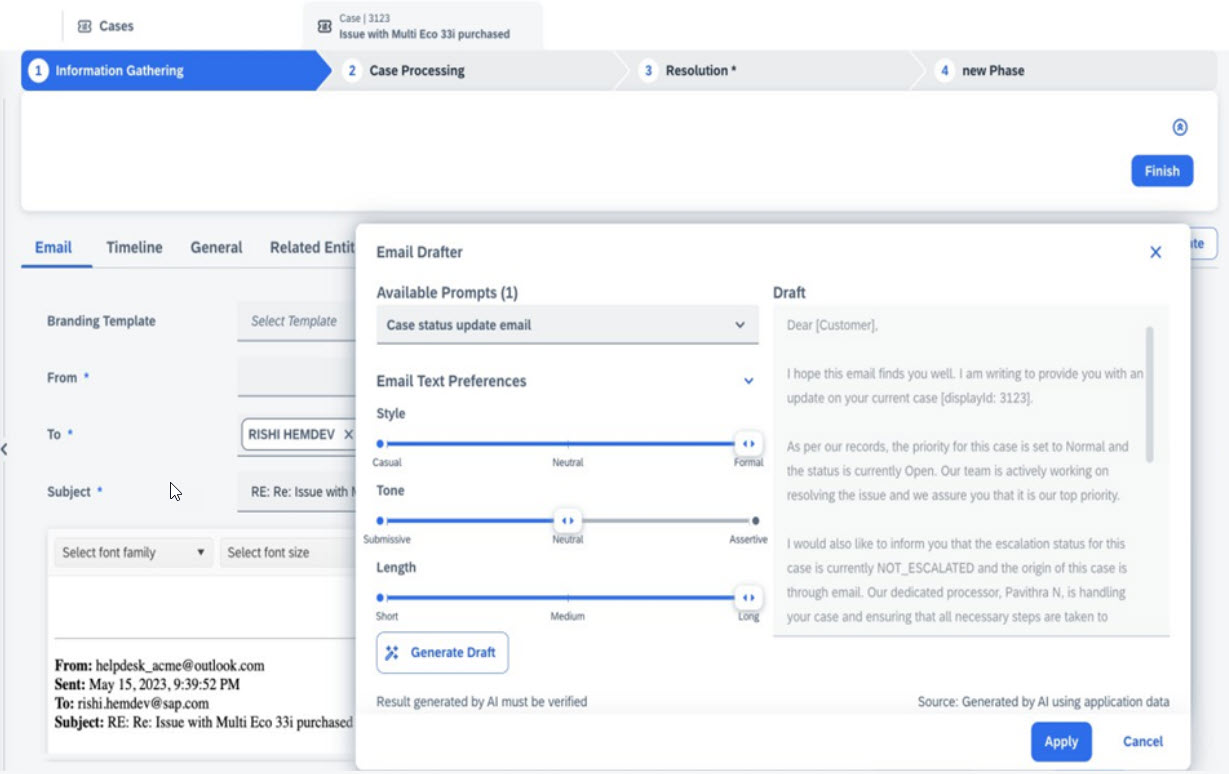
Users can review, edit, or regenerate the draft before sending, so the final communication remains under their control.
Email Drafter can also be used for:
- generating meeting minutes after a meeting
- preparing product proposals
- communicating about sales quotes or orders
Business value
- Reduce time spent drafting customer emails and follow-ups
- Generate context-aware communications using CRM data
- Better consistency, grammar, and professionalism across sales and service communications
Capability 7: AI-assisted duplicate detection
Duplicate customer records can lead to inaccurate reporting, incomplete customer histories, and inconsistent sales activities.
SAP Sales Cloud helps keep customer data clean by identifying potential duplicate records for accounts, contacts, individual customers, and leads.
AI compares multiple fields and the record as a whole, so it can find duplicates even when the information is incomplete or recorded in different formats. It doesn’t just look for exact matches.
AI also helps prevent duplicates in sales and service business objects.
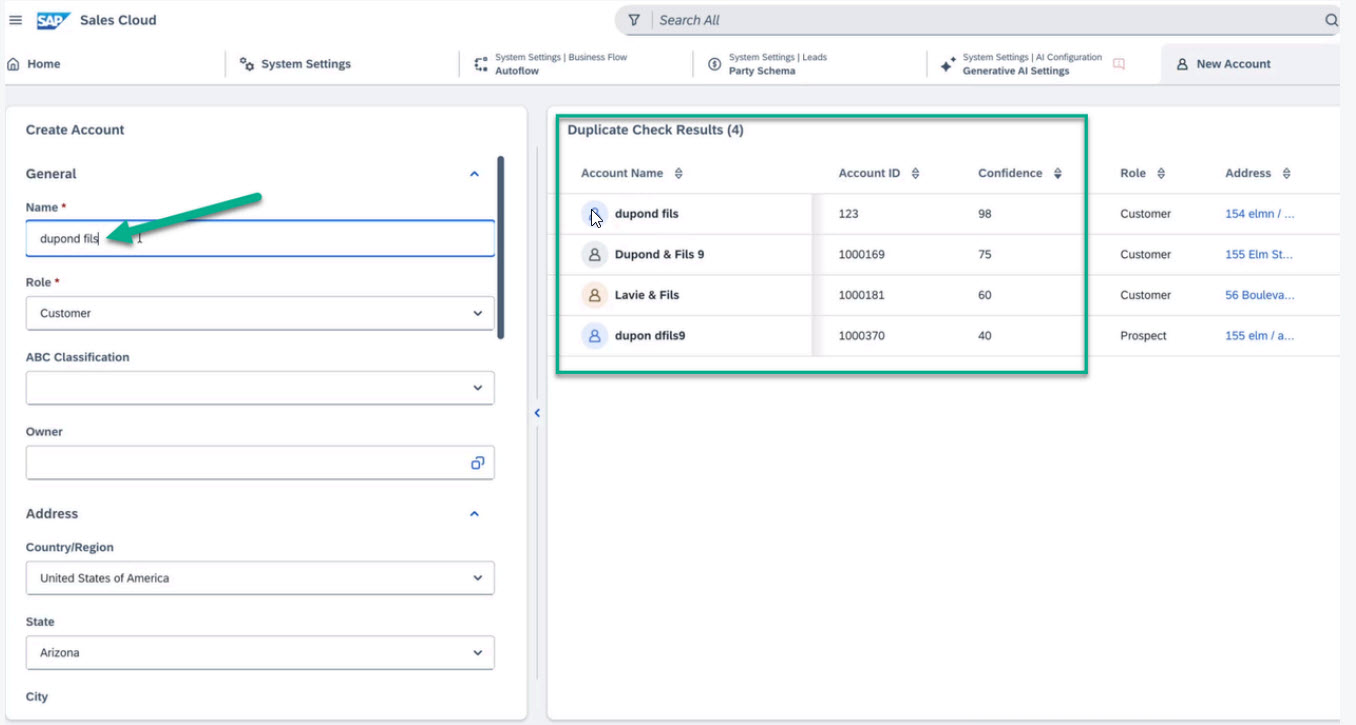
For each potential duplicate, the system displays a Confidence Score, indicating how confident it is that these are the same customer. However, it’s the user who decides whether the records are duplicates and whether to merge them.
Business value
- Reduce duplicate customer records in the CRM
- Improve the accuracy and consistency of customer data
- Build a more reliable customer view across sales processes
- Increase the quality of reporting, analytics, and AI-driven insights
Capability 8: Case Summary in SAP Service Cloud
Customer service agents often need to review a long case history and previous customer communications before they can understand the current issue.
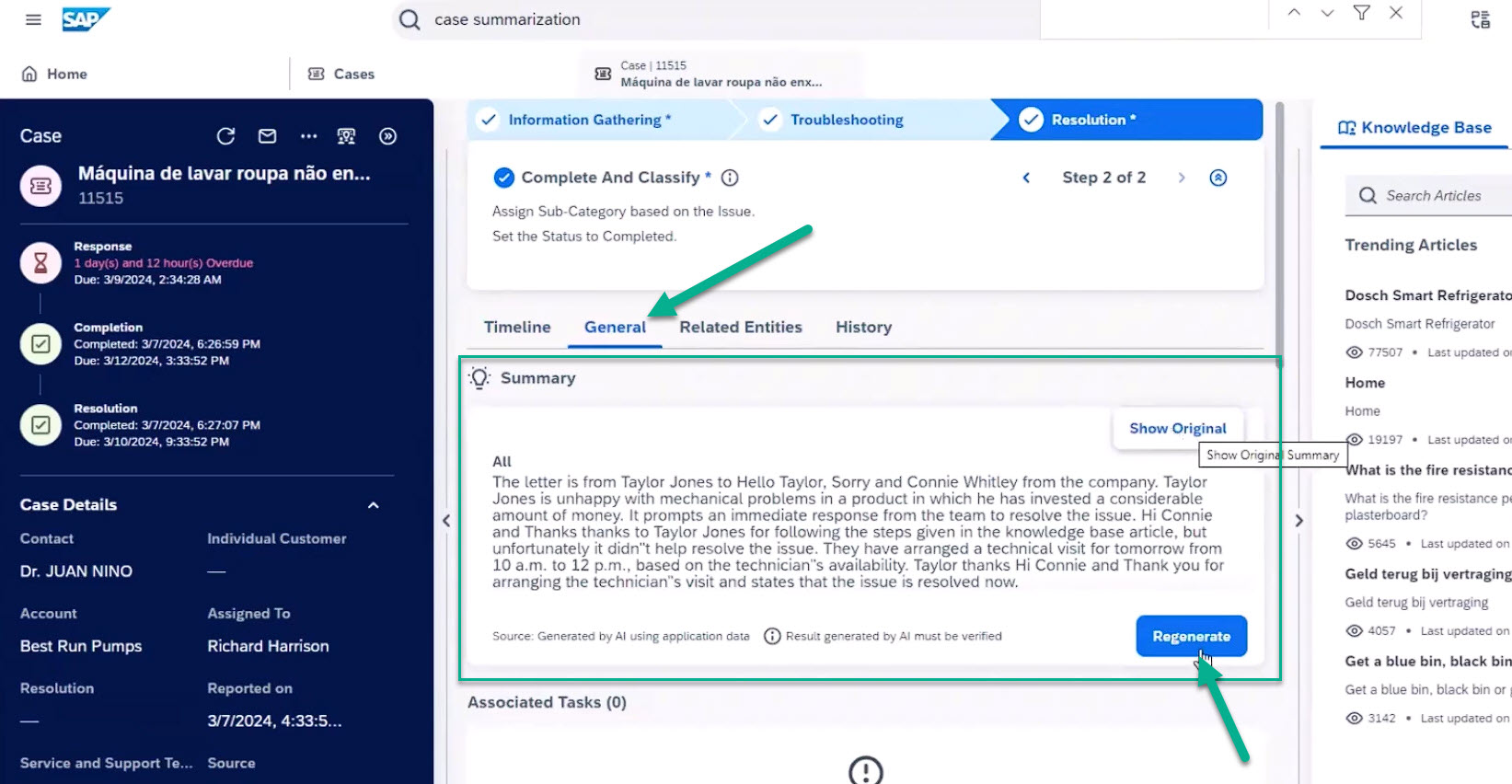
Case Summary uses AI to summarize the case history and customer communication, giving service agents a concise overview of the case and its current status.
This is especially useful when a case is transferred between service agents or when an agent needs to quickly get back up to speed after a break. Instead of reading the full communication history and searching through case data, the agent can start with the latest case summary.
Business value
- Reduce time spent reviewing case history and customer communications
- Help agents understand the current case status faster
- Make case handovers between service agents easier
- Provide a consistent overview of the case before further action
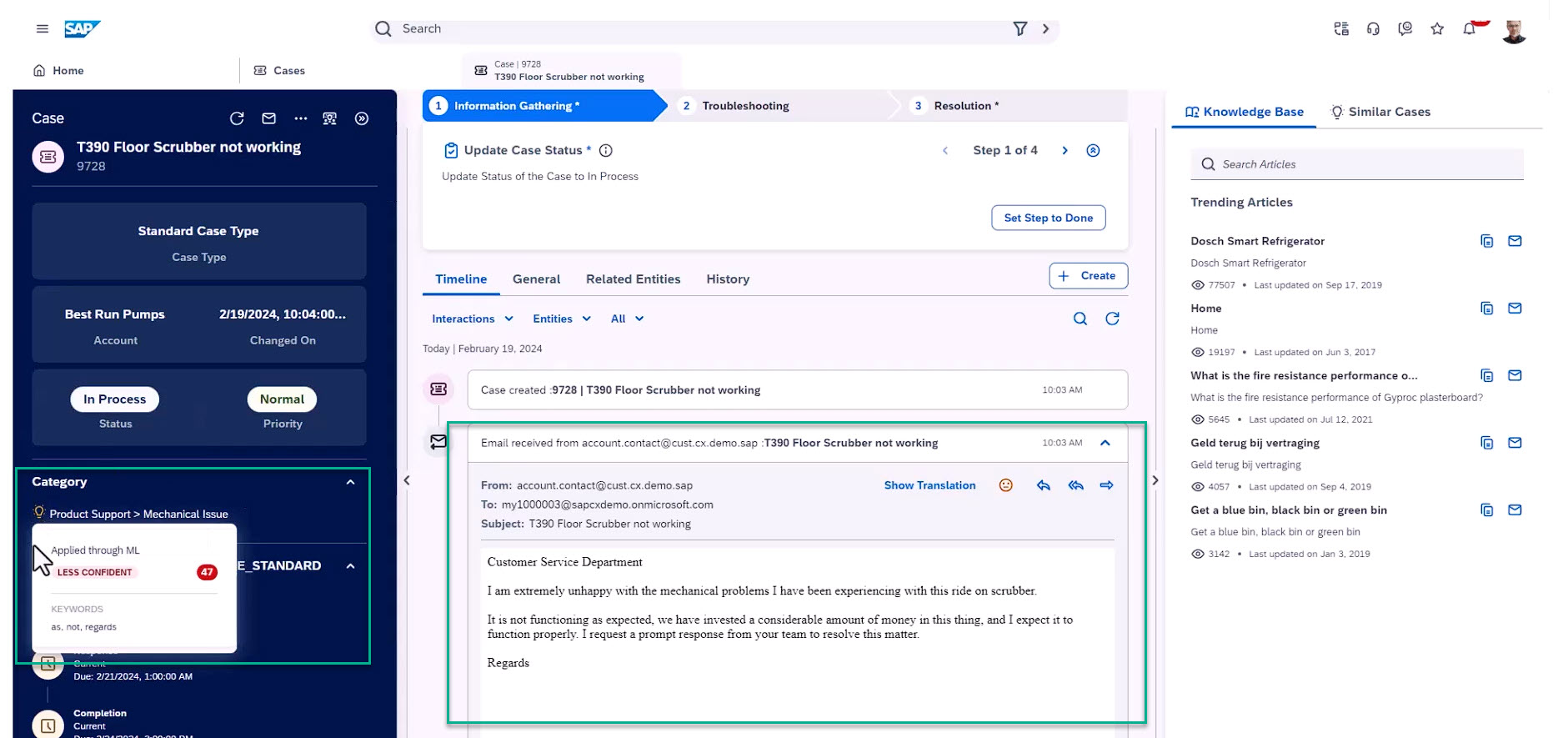
Capability 9: Case Categorization & Case Type Determination
Case Categorization identifies the relevant category and subcategory of a customer request, reducing manual classification and helping organize cases for routing, prioritization, and reporting.
Case Type Determination identifies the appropriate type of case based on the available case information. This helps the system assign the case correctly and start the appropriate handling process.
Together, these AI features reduce manual case classification and help ensure that cases are consistently assigned to the right category and type.
Business value
- Reduce manual case classification
- Improve consistency of case categorization
- Support faster and more accurate case routing
- Help apply the appropriate service process to each case
- Improve the quality of service reporting and analytics
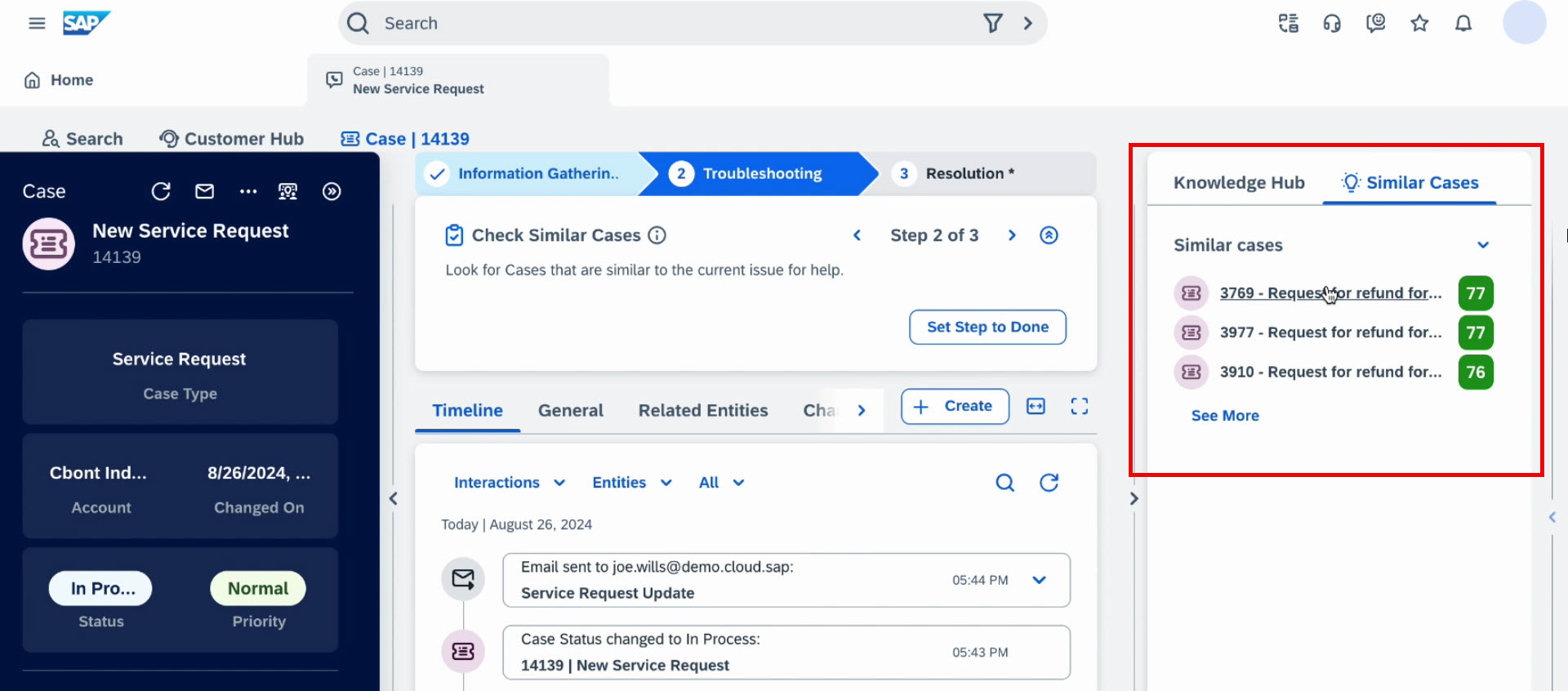
Capability 10: Similar Case Recommendation
SAP Similar Case Recommendation helps service agents find relevant solutions faster. AI analyzes the current case and finds the most similar previously resolved cases.
Instead of matching only keywords, AI understands the meaning and context of the case description, helping find similar cases even when different words are used.
Each recommendation includes a Confidence Score to show how closely the cases match.
Business value
- Find relevant solutions faster
- Reduce case resolution time
- Reuse knowledge from previous cases
- Improve agent productivity
- Deliver more consistent service
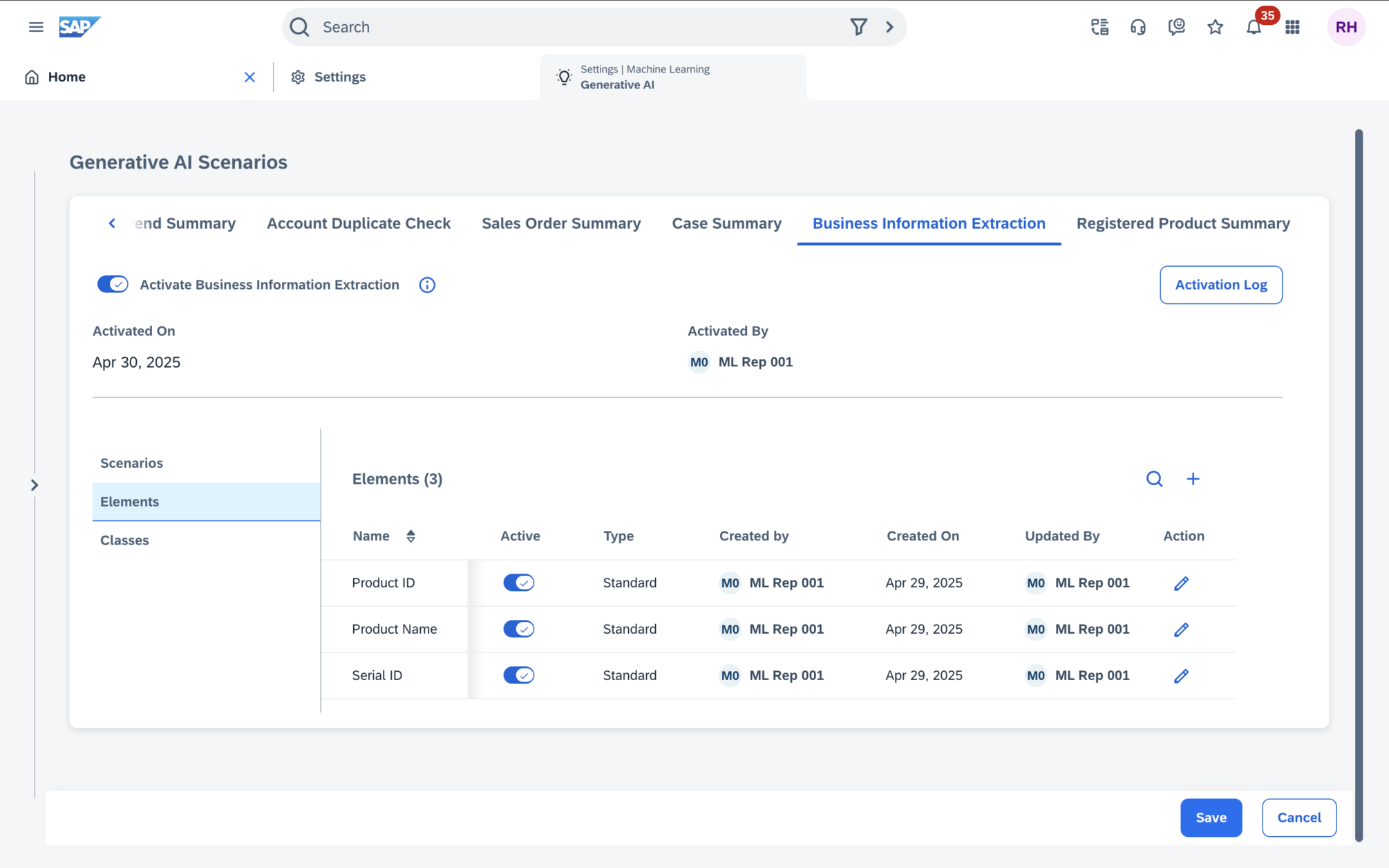
Capability 11: Entity Extraction (Business Information Extraction)
Entity Extraction (Business Information Extraction) helps service agents automatically identify important business information in incoming emails and documents.
AI extracts product IDs, serial numbers, and other relevant entity references and converts them into structured case data. This reduces the need to manually find and link information in customer messages.
The extracted information identifies relevant case details and helps agents handle customer issues faster.
Business value
- Reduce manual work when processing emails and documents
- Find product and serial number references faster
- Higher customer satisfaction
3. Joule: AI Copilot
Capability 12: AI Copilot
Joule is a generative AI assistant integrated directly into SAP Business Suite, including SAP Sales and Service Cloud. Joule understands the user’s business context and works directly with corporate data stored in SAP applications. So, it’s not an ordinary AI assistant; it understands your business logic, while third-party AI providers do not have direct access to that SAP context by default.
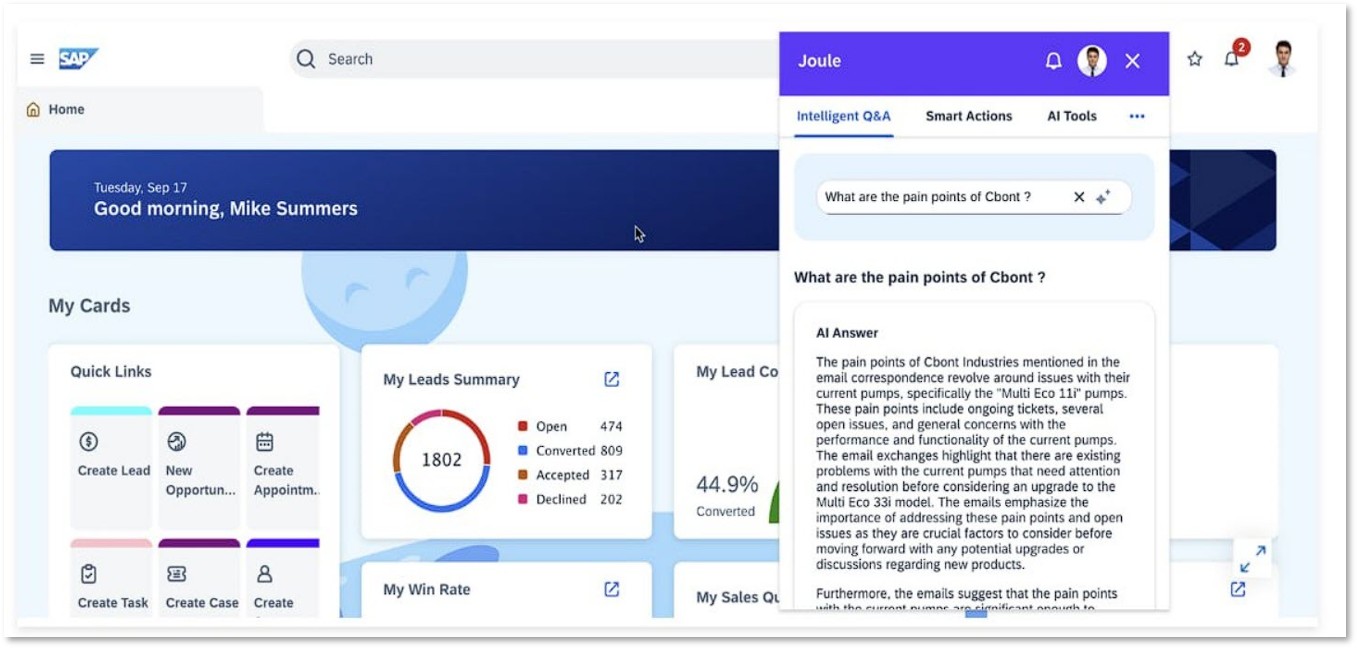
It reduces the time sales managers spend searching for information across CRM records, customer communications, events, and deals. They can quickly find and summarize information using natural language. Joule generates brief summaries of customers and potential deals, displays recent customer engagements, identifies key changes, and provides contextual analytics to help salespeople prepare more effectively for meetings.
Joule operates in accordance with user access rights and SAP security settings. Joule displays only information that the user is authorized to see and doesn’t share customer data with third-party AI providers for training or improving their models.
Business value
- Cut the time spent searching through CRM records and sales activities
- Speed up preparation for client meetings
- Provide sales teams with faster access to up-to-date analytics on customers and potential deals
- Ensure the secure use of generative AI based on reliable corporate data
What’s next for AI in SAP Sales and Service Cloud?
SAP is moving Sales and Service Cloud toward more agentic AI. The focus is shifting from AI that only provides recommendations or generates content to AI agents that can understand user intent, work with business context, and help execute business processes. SAP describes Joule Agents as AI agents that automate workflows, while Joule Assistants coordinate agents and turn user intent into action.
This direction is part of SAP’s broader Autonomous CX strategy. In sales, SAP is introducing the Sales Assistant, which orchestrates AI agents to support sellers across the deal cycle, from analyzing interactions and identifying pipeline risks to recommending next-best actions, creating follow-up tasks, and updating opportunities. In service, the same direction includes assistants such as Case Management Assistant and Service Management Assistant, designed to support case investigation, resolution, and service execution.
For example, for SAP Sales Cloud, SAP has already announced several planned AI innovations for Q4 2026:
- Email Insights Agent — analyzes incoming emails, extracts relevant data, and generates actionable insights.
- Assisted Order Capture with Pricing Agent — supports sales reps with pricing proposals based on historical and current sales and pricing data.
Conclusion
AI in SAP Sales and Service Cloud is becoming part of everyday sales and service work. It helps teams prioritize leads and opportunities, improve forecasting, prepare for customer meetings, recommend products, draft emails, resolve cases faster, and keep CRM data accurate.
The next step is agentic AI. SAP is expanding Joule and AI agents to move from simply providing information and recommendations toward supporting and automating business actions.
Frequently Asked Questions
Does SAP Sales and Service Cloud AI cost extra?
Not always. It depends on the capability. Currently, Base AI is included with SAP cloud subscriptions at no additional cost, while Premium AI capabilities, including AI agents and selected advanced AI services, are consumed through SAP AI Units. The exact cost depends on the feature, product subscription, and usage.
Can SAP AI recommendations be customized for each business?
Yes, for selected AI scenarios. Recommendations can reflect company-specific CRM data, configuration, and supported custom fields. SAP AI can also use your company’s historical CRM data and business context to provide more relevant recommendations. The better and more representative the underlying data, the more accurate and useful the results can be.
Can SAP AI work with custom CRM fields and processes?
Yes, for supported scenarios. For example, SAP Sales Cloud Version 2 allows selected custom fields to be used in opportunity scoring models. At the same time, SAP Service Cloud Version 2 supports custom fields in business information extraction. However, not every AI feature supports custom fields or custom processes.
How does SAP protect customer data when using AI?
SAP applies security and privacy controls such as tenant isolation, access controls, data minimization, and masking where applicable. Customer data is processed under SAP’s data protection and Responsible AI requirements and is not shared with third-party LLM providers for training their models. Data processing follows applicable privacy requirements and SAP Policies.
What data does SAP AI use for suggestions and analyses?
It securely uses enterprise data. Sales AI may use historical opportunities, sales records, and selected CRM fields. Service AI can analyze case subjects, descriptions, categories, and historical cases. Some capabilities can also use related business data or knowledge sources to provide contextual recommendations. The available data depends on the model, configuration, and feature requirements.

Subscribe