

Tatsiana Padrez, Head of SAP CX Cloud & Marketing at ACBaltica
SAP Cloud for Customer (SAP C4C) is SAP’s cloud CRM suite, including SAP Sales Cloud and SAP Service Cloud, providing essential tools for sales processes and customer service operations.
To address changing customer expectations, cloud adoption, and advances in AI, SAP introduced SAP C4C Version 2 (SAP Sales Cloud Version 2 and SAP Service Cloud Version 2) – a modern cloud platform with embedded AI capabilities, a new user interface, smarter automation, and a cloud-native architecture.
In this blog, we compare SAP C4C Version 1 (SAP C4C V1) with SAP C4C Version 2 (SAP C4C V2), helping you understand what’s new, what’s improved, and what to consider if you’re planning a transition.
What is SAP Sales Cloud V1?
SAP C4C V1 is a cloud-based CRM solution launched by SAP in 2011 as part of its customer engagement portfolio. It combines customer data, sales activities, and service operations into a single cloud platform and integrates with SAP back-end systems such as SAP ERP and SAP S/4HANA.
Built on SAP’s original cloud platform, C4C V1 provides a mature and feature-rich CRM environment with support for mobile users, embedded analytics, and extensive customization capabilities.
Key components in SAP C4C V1
SAP Sales Cloud
SAP Sales Cloud is used for lead and opportunity management, account and contact management, visit planning, activity tracking, forecasting, and sales analytics. It includes some basic marketing features such as campaign execution and lead nurturing.
SAP Service Cloud
SAP Service Cloud is primarily used for case management, SLA tracking, field service, knowledge base, and customer self-service.
Core features of C4C V1
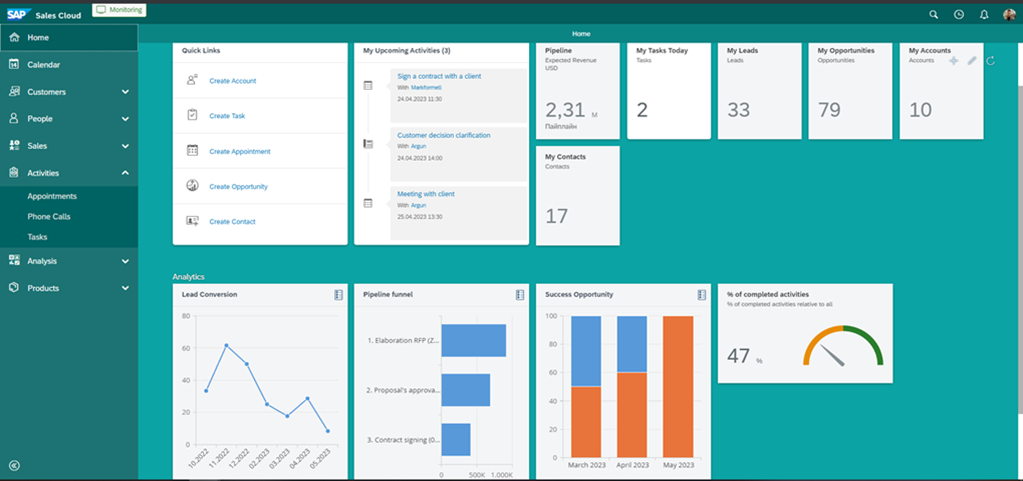
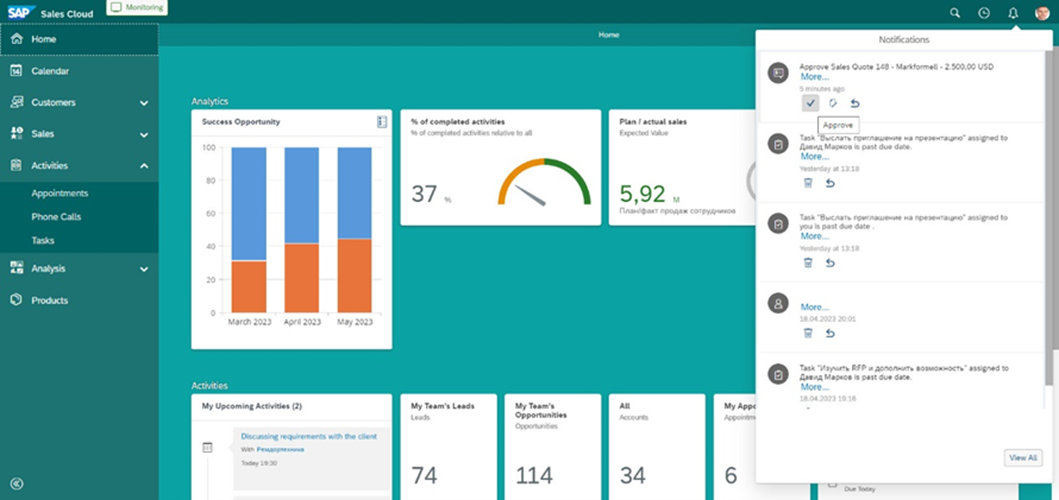
The system runs on SAP’s own cloud platform with a user interface based on early SAP Fiori and HTML5. Organizations can adapt the solution to their business needs through in-app configuration and custom development using SAP Cloud Application Studio (SDK).
Reporting & Analytics
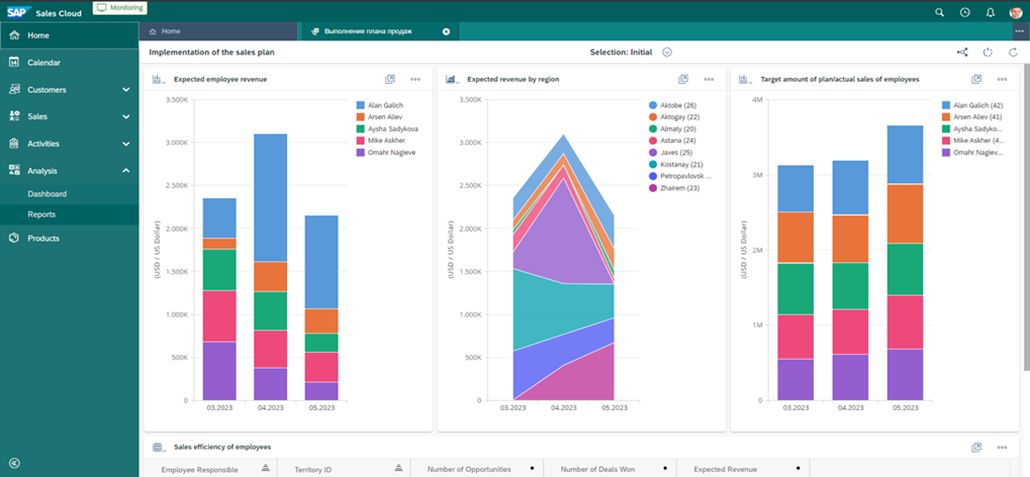
C4C V1 includes embedded analytics based on SAP BusinessObjects with built-in reports and dashboards.
Users can customize reports based on standard business objects to support specific business processes and reporting requirements.
Integration & Extensibility
SAP C4C V1 integrates with SAP ERP and SAP S/4HANA using standard integration content through SAP Integration Suite (formerly SAP Cloud Platform Integration) or SAP Process Integration / Process Orchestration (PI/PO).
Organizations can also extend the application using SAP Cloud Application Studio, enabling custom business objects, user interface extensions, business logic, and integrations.
What is SAP C4C V2?
SAP C4C V2 keeps the same core purpose as SAP C4C V1. It manages sales and customer service, but delivers it in a more advanced, up-to-date way, aligned with modern business trends, UX standards, and AI capabilities.
Rather than being a simple upgrade, SAP Sales Cloud Version 2 and SAP Service Cloud Version 2 represent a new generation of SAP CRM applications.
Why SAP introduced C4C V2
Over time, users of SAP C4C V1 began to face limitations in user experience and modern capabilities. These strategic priorities required a fundamentally new platform architecture, so SAP shifted toward cloud-native architecture, clean core, and an AI-first strategy.
As a result, SAP launched SAP C4C V2 in late 2023. It was a completely new product, rebuilt from the ground up on SAP Business Technology Platform (BTP).
Key innovations of SAP C4C V2
-
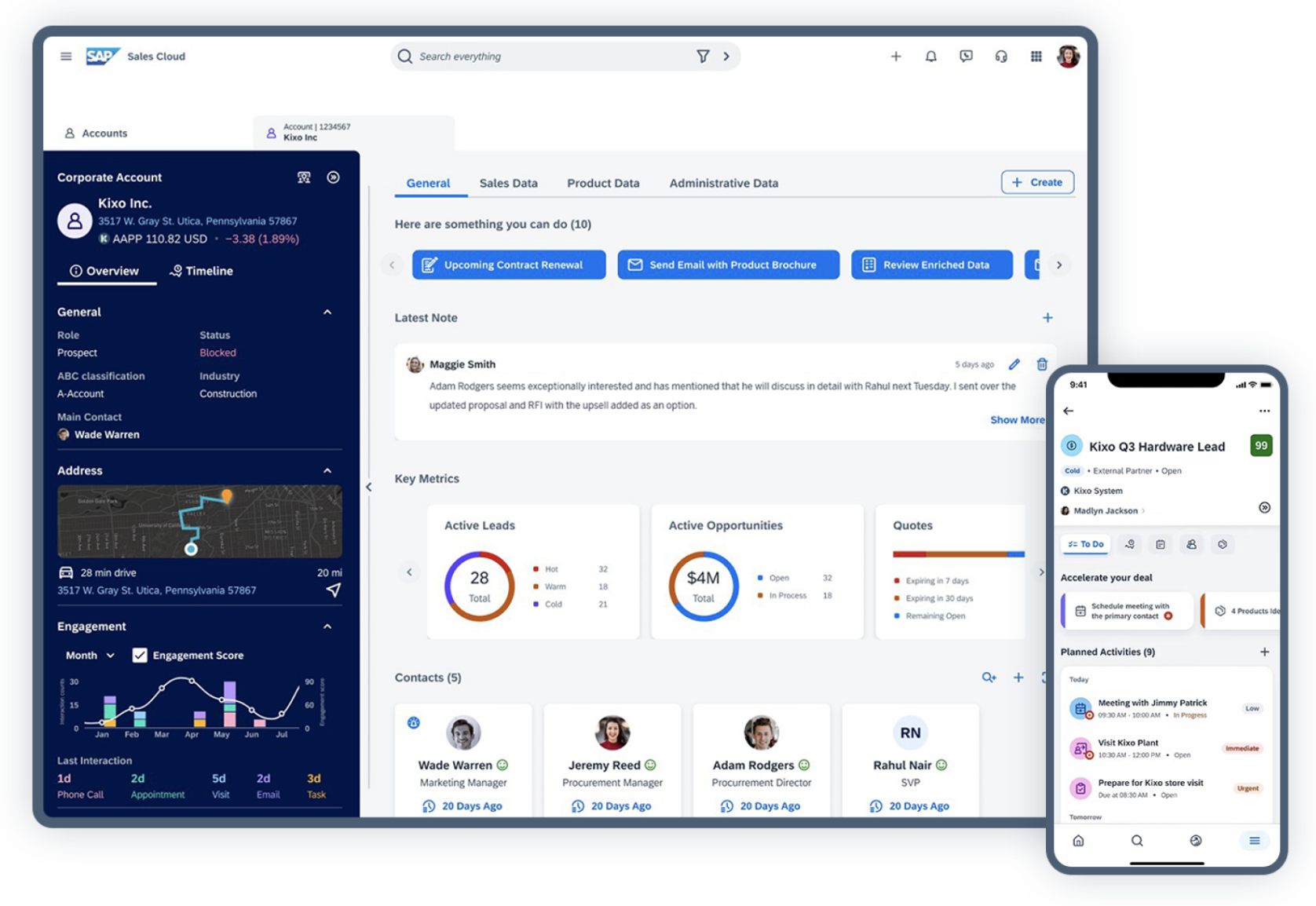
Modern, intuitive Fiori 3 interface designed for ease of use
-
Embedded and add-on AI via SAP Joule, offering smart, contextual recommendations
-
Low-code/no-code extensibility with SAP Build for faster customizations, or deeper extensions via SAP BTP
-
Real-time, event-driven integration with S/4HANA and other systems
-
Sales-first focus, with service capabilities being rolled out gradually
SAP C4C V1 vs. V2: Side-by-Side Comparison
The table highlights the key differences between SAP C4C V1 and the new generation of SAP Sales Cloud Version 2 and SAP Service Cloud Version 2.
Quick comparison
|
Feature / Area |
SAP C4C V1 |
SAP Sales & Service Cloud Version 2 |
|
Initial release |
Introduced in 2011 |
Next generation introduced in 2023 |
|
Platform |
Mature cloud CRM platform |
Next-generation cloud-native CRM platform |
|
User experience |
Classic SAP C4C interface |
Modern SAP Fiori experience with redesigned workspaces |
|
Sales productivity |
Traditional sales management |
Guided selling, Kanban pipeline and productivity-focused workspaces |
|
Analytics & Insights |
Standard reports and dashboards |
Embedded analytics, interactive KPI cards and business insights |
|
Artificial Intelligence |
No embedded AI capabilities |
Embedded AI with optional SAP Joule and generative AI features |
|
Business automation |
Workflow-based processes |
Intelligent recommendations and enhanced workflow automation |
|
Revenue management |
Basic revenue attribution |
Flexible revenue split across multiple sales participants |
|
Integration |
Standard integration with SAP ERP and SAP S/4HANA |
API-first and event-driven integration through SAP Integration Suite |
|
Extensibility |
Cloud Application Studio (SDK) and in-app customization |
In-app extensibility and side-by-side extensions on SAP BTP |
|
Innovation approach |
Stable platform with regular enhancements |
Continuous innovation with AI, automation and frequent cloud updates |
SAP C4C V1 vs. SAP C4C V2: What the differences mean
The table highlights the key differences. The sections below explore each area in more detail to help you understand how the two versions differ in real-world scenarios.
Platform & architecture
SAP C4C V1 was designed as SAP’s first-generation cloud CRM platform and has supported organizations worldwide for more than a decade. It provides a mature, reliable environment for managing sales and service processes, offering extensive functionality and flexibility.
SAP C4C V2 introduces a new cloud-native platform designed to support SAP’s long-term cloud strategy. SAP redesigned the platform to enable faster innovation, improved scalability, and more frequent delivery of new capabilities.
What this means for your business:The biggest difference is the pace of innovation. SAP C4C V1 remains a mature and supported solution. SAP C4C V2 is designed to receive continuous enhancements, which means new capabilities including AI, automation, and productivity improvements.
User experience
SAP C4C V1 provides a traditional SAP interface with navigation and layouts familiar to long-time users. It’s highly functional and can be customized for each user role.
SAP C4C V2 introduces a redesigned intuitive SAP Fiori UI with modern workspaces, simplified navigation, and role-based layouts. Here, SAP also introduced visual tools such as Kanban boards for opportunity management, making sales pipelines easier to understand and manage.
What this means for your business: A modern user experience can improve user adoption, reduce onboarding time for new employees, and increase productivity by allowing sales and service teams to spend less time navigating the system and more time engaging with customers.
Sales productivity
In SAP C4C V1, sales teams can manage opportunities, accounts, activities, forecasts, and customer interactions through structured business processes supported by traditional list-based views.
SAP C4C V2 emphasizes sales productivity with guided selling, modern workspaces, opportunity insights, and visual pipeline management. They help sales prioritize activities and focus on the most valuable opportunities. Flexible revenue split capabilities also make it easier to recognize contributions from multiple participants involved in complex sales cycles.
What this means for your business: SAP C4C V2 is a good choice if you want to improve sales efficiency. One of its core goals is to simplify everyday work and help sales teams be efficient.
AI & Automation
SAP C4C V1 does not include embedded AI. Business processes rely primarily on predefined workflows and user actions.
SAP C4C V2 stepped into the future. Artificial intelligence is one of its defining characteristics. SAP has introduced embedded AI capabilities together with SAP Joule and optional generative AI features that support users with contextual recommendations and productivity assistance. Workflow automation has also evolved, helping organizations reduce repetitive manual activities.
What this means for your business: In SAP C4C V2, AI is designed to support daily decision-making and reduce routine work.
Analytics & Business insights
SAP C4C V1 provides embedded analytics, reports, and dashboards that help monitor sales performance. Reports can be customized to support different business requirements.
SAP C4C V2 expands these capabilities with interactive dashboards, rich data visualizations, and business insights integrated directly into users’ workspaces. Real-time nalytics become more accessible, while AI-powered insights highlight trends and opportunities.
What this means for your business: SAP C4C V2 offers better visibility into business performance and enables managers to monitor pipelines, identify trends, and make faster decisions.
Integration
SAP C4C V1 supports a mature and extensive integration landscape, including SAP Cloud Integration (CPI), SAP PI/PO, web services, APIs, and SAP-delivered integration content for SAP ERP and SAP S/4HANA. It covers a broad range of established master-data, sales, and service scenarios, including integration with legacy and hybrid SAP landscapes.
SAP C4C V2 continues to use SAP Cloud Integration and prebuilt integration packages for SAP ERP and SAP S/4HANA. At the same time, its integration architecture is increasingly aligned with SAP BTP, modern REST and OData APIs, master-data services, and event-driven communication. This provides a more cloud-oriented foundation for new SAP landscapes.
What this means for your business: Instead of building integrations from scratch, organizations can take advantage of SAP’s prebuilt integration scenarios for common business processes. This helps accelerate implementation, reduce project costs, and simplify long-term maintenance.
Extensibility
SAP C4C V1 can be adapted through configuration and custom development, enabling support for highly specific business requirements.
SAP C4C V2 continues to support customization while placing greater emphasis on clean core, so you can extend out-of-the-box functionality via in-app extensibility (for small ones)or via SAP BTP (for larger ones)
What this means for your business: Both systems allow for customisation to specific business processes.
Security & Compliance
Both versions provide enterprise-level security. The difference lies primarily in SAP’s ongoing investment in cloud security and compliance as part of its long-term cloud strategy.
Mobile experience
In SAP C4C V1, mobile access has long been a core capability, allowing sales and service employees to work remotely and access customer information in the field.
SAP C4C V2 continues to support mobile work through its modern SAP Fiori interface.
What this means for your business: A consistent user experience across devices helps employees remain productive whether they are working in the office, visiting customers, or supporting field operations.
Is SAP C4C V1 still a good choice?
Despite the growing attention around SAP C4C V2, SAP C4C V1 continues to be a capable CRM solution for many organizations.
For many existing customers, SAP C4C V1 continues to meet business requirements. It supports core sales and service processes, including customer management, opportunity management, service operations, analytics, and integration with SAP ERP and SAP S/4HANA.
SAP C4C V1 is the right choice if your organization:
-
already has a well-established CRM environment
-
relies on business processes that are already heavily customized
-
does not currently require the newest AI capabilities or cloud innovations
What this means for your business: Choosing to remain on SAP C4C V1 is not wrong if this platform aligns with your business priorities and strategy.
Who Should Consider Migrating to SAP C4C V2?
Here are some common scenarios for moving to SAP C4C V2:
-
Organizations start a new CRM project: If you’re implementing SAP CRM for the first time, SAP C4C V2 is generally the platform aligned with SAP’s future product strategy. It provides access to SAP’s latest user experience, embedded AI capabilities, and continuous innovation model.
-
Organizations want AI and automation: Companies looking for AI, intelligent recommendations, and workflow automation are likely to benefit from SAP C4C V2, where SAP invests in these capabilities.
-
Organizations adopt SAP’s cloud strategy: If your business is already investing in SAP S/4HANA Cloud, SAP Business Technology Platform, SAP Build, or SAP’s broader cloud portfolio, SAP C4C V2 fits naturally into this ecosystem.
-
Organizations plan long-term innovation: Businesses that expect their CRM platform to evolve alongside new SAP capabilities should consider the implementation of SAP C4C V2. Here, SAP continues to introduce new functionality through regular cloud releases, allowing customers to benefit from ongoing innovation without major platform changes.
However, migration may not be an immediate priority for each case. Companies may prefer to continue using the SAP C4C V1 solution as it is well-established and still supported. There is no single migration timeline that fits every organization.
Migration to SAP C4C V2: Key points to consider before migrating
Migrating from SAP C4C V1 to SAP C4C V2 is a move to a new product built on a different technical foundation. It requires setting up a new system, reconfiguring it, and carefully planning data transfer, but it’s also a valuable opportunity to start fresh with SAP C4C V2’s new features and improvements. And here are a few moments that you should consider before migration:
1. Usage of standard version
If your current setup relies mostly on standard (out-of-the-box) features of SAP C4C V1, the migration should be smooth. The earlier the migration, the better, especially as SAP C4C V2 evolves quickly and brings more built-in capabilities over time. That’s why the sooner you start developing and adapting the system, the more benefits it can deliver to your business.
2. Heavy customizations
If you have such customizations, then here’s your roadmap:
- Identify which customizations are essential to carry over for your actual business needs.
- Review which customizations can be covered by SAP C4C V2’s standard (out-of-the-box) features, as some SAP C4C V1 customizations are already built in.
- Evaluate remaining gaps
- Plan how to address them using SAP BTP or SAP Analytics Cloud (SAC). Note: These may require additional licenses.
- Check the product roadmap, as SAP is actively evolving SAP C4C V2, and some missing features may already be planned for upcoming releases.
- Assess and adjust integrations: some may need redesign for the new platform.
3. Extensibility considerations
In SAP C4C V1, extensibility relies on:
-
Key User Tools (simple UI changes, added fields, business rules)
-
Cloud Application Studio (PDI/SDK) (custom objects, screens, logic)
Customizations are done inside the system, offering flexibility but complicating upgrades and maintenance. In SAP C4C V2, the approach is clean core + side-by-side extensibility:
-
Low-code/no-code configurations (role-based workspaces, cards, UI adaptation)
-
Advanced extensions via SAP BTP (apps, integrations, AI features
This reduces upgrade risks and improves scalability.
Note: it requires new developer skills and SAP BTP licenses.
4. Custom reporting
SAP C4C V1 offers more flexibility to create custom reports directly inside C4C.
SAP C4C V2 can give you good out-of-the-box standard reports and dashboards, but with a fixed structure.
If your business needs fully custom reporting, it will require extra effort and additional costs in SAP Analytics Cloud (SAC).
Recommendation: Since the out-of-the-box analytics are really good, I recommend starting with SAP C4C V2’s standard reports for the first 3-6 months, then assessing whether additional custom reports are truly needed. Many customers find the standard options sufficient.
Customization is still possible, but it typically requires using SAP BTP.
5. Cost and prioritization
Before migration, it’s important to assess and prioritize the fit-gap results of custom developments and reporting needs. As part of this, evaluate the financial impact, including whether additional licenses (such as SAP BTP or SAC) will be required, and to what extent.
Recommendation: Prioritize gaps carefully and decide which custom elements are critical to bring into the migration and which can be phased out in favor of modern standard functionality.
Conclusion
SAP C4C V1 is still supported and can continue to serve your business if it meets your current needs. At the same time, it’s a good moment to explore SAP C4C V2 and start planning a smooth transition to take advantage of its modern capabilities, unlock new value for your sales operations, and stay ahead in today’s market. With a thoughtful and well-structured migration, the transition can be efficient and successful.
Planning your migration to SAP Sales Cloud V2 right now? Our SAP CX consultants can assess your current C4C landscape, identify migration risks, and create a roadmap tailored to your business.
FAQ
Is SAP C4C V1 still supported?
Yes. SAP C4C V1 remains a supported CRM solution. At the same time, SAP’s primary innovations are focused on SAP C4C V2.
Is SAP SAP C4C V2 an upgrade to SAP SAP C4C V1?
No. SAP C4C V2 is a new generation of SAP CRM applications, not a direct technical upgrade.
Can I continue using SAP C4C V1?
Yes. If SAP C4C V1 meets your business needs, you can continue using it.
Can custom developments be migrated?
It depends. Existing customizations need to be reviewed during migration because SAP C4C V2 uses a different extensibility approach. You can adapt some developments; others may need to be redesigned.
Does SAP Joule require additional licensing?
In most cases, yes. SAP Joule and some generative AI capabilities are licensed separately, depending on your SAP subscription.
Is SAP BTP mandatory for SAP C4C V2?
No. SAP C4C V2 works without SAP BTP. However, SAP BTP is recommended for advanced integrations, automation, and custom extensions.
How long does migration typically take?
The duration depends on your system size, integrations, customizations, and business processes. A migration assessment is the best way to estimate effort.
Should new customers choose SAP C4C V1 or SAP C4C V2?
For most new CRM implementations, SAP C4C V2 is the recommended choice. It aligns with SAP’s long-term cloud strategy and receives the latest innovations, including AI capabilities and regular feature updates.

Subscribe