

Maksim Ablameiko, Senior BI & Analytics Consultant at ACBaltica
SAP is officially ending support for the on-prem version of SAP Business Warehouse (SAP BW) and moving to the cloud (SAP Business Data Cloud). The classic BW platform will be supported until 2027, with the option of extended support through 2030 (for an additional fee). Support for BW 7.5 will carry on through to 2030 at no extra cost. For many companies, the need to migrate from SAP BW is a significant change, as SAP BW has been a reliable foundation for business analysis for decades.
Businesses that are still using the solution need to decide on their strategy: will they remain on-prem or move to the cloud? This article explores three main approaches to BW-BDC migration and explains how to choose the right one for your business.
What is SAP Business Data Cloud (BDC)
BDC is a unified, licensed platform that consolidates SAP services for corporate data management.
It includes:
-
SAP Datasphere for data integration and modeling
-
SAP Analytics Cloud for analytics and planning
-
Databricks (in a more limited edition, but still highly functional) for advanced data processing and ML
-
BW Private Cloud Edition (BW PCE) as a transition layer for existing models
-
Infrastructure services for data integration and storage
The main goal of BDC is to create a single data layer that connects SAP systems, non-SAP sources, analytics tools, and AI use cases, delivering data with built-in business meaning, governance, and zero-copy context ready for AI agents.
Data organisation differences: BW vs. BDC
When choosing a migration strategy, remember that BDC and SAP BW handle data differently. This affects how data is organized, shared, and used.
BW’s model is built around its own object types:
-
InfoObjects carry attributes, hierarchies, texts, and conversions.
-
ADSOs and CompositeProviders compose them into layered marts.
-
BEx (Business Explorer) Queries form the semantic layer. Analysis authorisations control row-level access.
None of these exist in Datasphere. Instead, there are Spaces, which are governed logical containers, and different kinds of artifacts: tables and views as primary modelling blocks, analytic models as the semantic layer, and Data Access Controls (DACs) for row-level security. SAC consumes analytic models directly, so Datasphere has no equivalent to BEx.
This difference directly affects the migration strategy.
Migration from BW to Business Data Cloud (BDC) should not be approached as a simple conversion of BW objects. The initial phase involves classifying the existing BW landscape according to its intended future role. Critical and stable BW data flows can then be migrated to the cloud and maintained. Valuable BW datasets may be published as BDC data products. Use cases that require a refined semantic model should be redeveloped within Datasphere. Outdated reports and technical layers should be decommissioned.
The migration path depends less on the “amount of transformation” and more on whether this BW logic should be kept, exposed, redesigned, or removed.
SAP BW migration strategies: Three proven paths to SAP Business Data Cloud
There is no universally applicable migration scenario from SAP BW to BDC. The optimal path depends on factors such as the size and complexity of the existing BW, the volume of custom development, the level of transformation considered, and the number of existing and additional systems to be integrated into the future data architecture. These dimensions determine whether an organisation should prioritise stability, gradual transformation, or a full redesign. In this article, we examine these three main paths in detail.
1. Lift, Shift & Innovate
‘Lift, shift and innovate’ refers to the gradual transformation of legacy BW systems through migration to the cloud. This is the most common and recommended approach to SAP BW migration.
Lift: Migration to the cloud
At this stage, the current BW system is migrated to the BW Private Cloud Edition (BW PCE). BW is not changed and lifted as is. However, there are still some technical prerequisites: the BW system must run on SAP HANA and be upgraded to the minimum supported release or Support Package Stack level.
After migrating SAP BW to the cloud, the system continues to operate with minimal changes. However, if this is where the process ends, the company has simply obtained BW in the cloud without any real modernization. The data remain structured around BW-specific technical objects, which limits its consumption within BDC.
Shift: Transition to data products
During the Shift phase, BW data needs to be published as Data Products to make it available within BDC platform.
This is how it works in practice:
-
Existing models and data loads remain in BW.
-
Key info providers are selected (e.g. sales, finance, and procurement).
-
Using the BW Data Product Generator, these models are published externally.
-
SAP Datasphere then begins to consume them as ready-made business products.
As a result, SAP Datasphere can now use BW data without a full migration, rewriting ETL processes, or disrupting business operations.
Innovate: gradual modernization
New developments are already taking place in the cloud:
-
Creating new data models in Datasphere
-
Experimenting with ML and Databricks to enable AI-powered analytics scenarios, including predictive insights and advanced data processing
-
Development of analytical applications
Target architecture after migration
In most projects, the final state looks like this:
-
BW PCE serves as a stable core.
-
Selected InfoProviders are published as Data Products.
-
SAP Datasphere becomes the semantic layer for corporate data.
-
New developments are carried out exclusively in the cloud.
-
BW objects are gradually decommissioned where necessary.
Note: During the transition period, companies typically maintain two platforms simultaneously (BW and BDC). This is a normal and expected stage of the transformation process.
Which companies should consider this migration approach?
-
Companies with large, stable BW landscapes
-
Companies with limited resources for redesign
-
Organizations seeking to minimize the risks associated with change
The following visual representation shows the available paths and recommended approaches based on the environment:
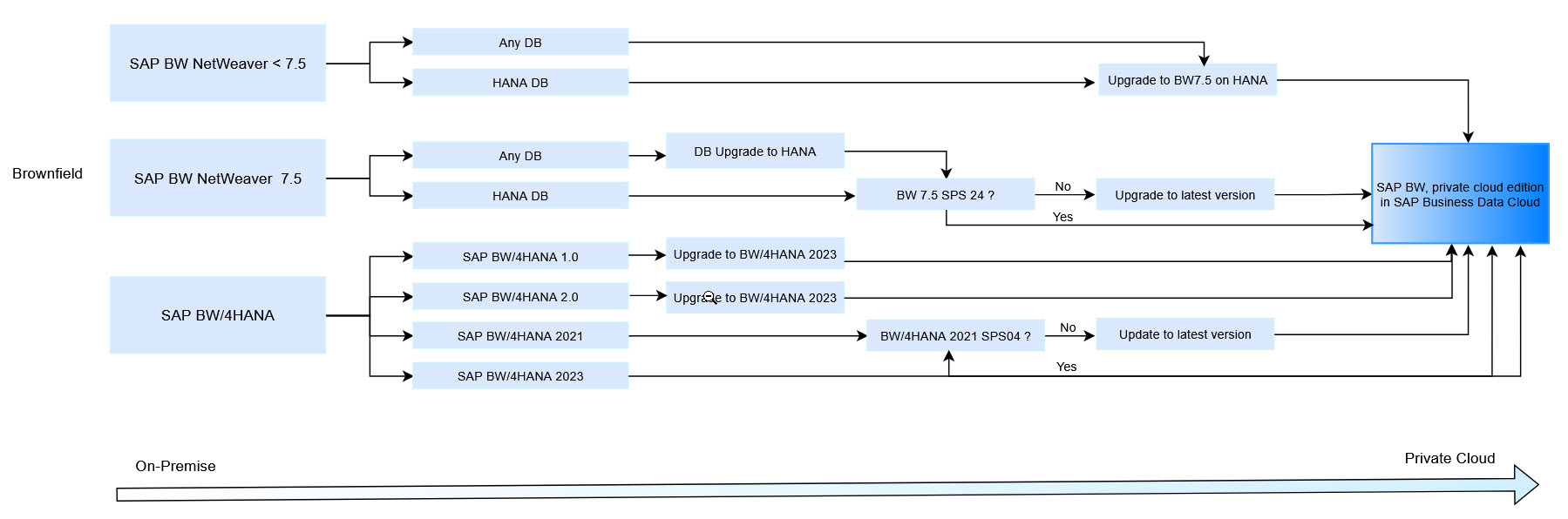
Follow this link to find out more.
2. BW Bridge + Datasphere (No full BW lifting)
This option uses the SAP BW Bridge, a specialised SAP transition layer within Datasphere.
SAP BW Bridge creates a compatibility layer between your existing BW environment and SAP Datasphere, enabling you to migrate in steps rather than starting from scratch.
What BW Bridge does
-
Reuses existing BW models and logic: You can bring over InfoProviders, ADSOs, transformations, and queries without rewriting them immediately.
-
Runs your BW processes in the cloud: Your current reports and ETL workflows keep working while hosted in a modern cloud environment.
-
Lets you modernize at your own pace: You can selectively rebuild or redesign data models directly in Datasphere over time.
-
Reduces migration risk: Because business logic and data models remain operational, the project can proceed in smaller, safer phases.
This migration approach is ideal for those who require rapid cloud onboarding, are not ready for a full transformation, and need to minimize project risks.
However, BW Bridge does not eliminate the need for redesign. It supports a defined scope of BW functionality, but not every object or custom development from an existing BW landscape can be carried forward unchanged. Some unsupported objects and custom code may need to be adjusted, rebuilt in Datasphere, or retired. In that sense, BW Bridge can postpone and structure the redesign effort, but it should not be mistaken for a complete modernization of the architecture.
Note: BW Bridge uses additional capacity within SAP Datasphere, so it’s important to clarify pricing and licensing details early in your planning.
For more information on restrictions and prerequisites, visit the following links:
How does BW Bridge differ from Lift & Shift?
|
Lift & Shift (BW PCE) |
BW Bridge |
|
The entire BW system migrates |
Selected and supported BW objects are converted or reused |
|
BW remains the central data warehouse |
Datasphere becomes the target data modeling and integration layer |
|
No changes to existing BW models |
Selective reuse, redesign, and modernization of BW models |
|
Longer dual landscape period |
Faster initial cloud transition for selected BW assets |
|
BW Stays (as a PCE) |
BW retires, BW Bridge is now a “BW logic holder” |
Lift & Shift (BW PCE) involves minimal change: the company migrates its existing BW to the cloud, retaining the current models, processes and role of BW as the central data warehouse. This option is suitable for organisations that prioritise stability and business continuity, as it reduces risks.
BW Bridge, on the other hand, is geared towards gradual transformation. BW ceases to be the primary data warehouse (DWH), and SAP Datasphere becomes the target platform for data modelling and integration. This approach modernises the architecture, reuses key BW business logic and enables a quicker transition to next-generation cloud analytics.
3. Greenfield in Datasphere
The Greenfield scenario is the most radical, involving a complete redesign of the architecture:
-
BW is completely decommissioned.
-
Data models are rebuilt in Datasphere.
This scenario does not use any transitional BW layer. This means that there is no BW PCE as a lifted core or BW Bridge as an intermediate compatibility layer. The future-state architecture is built directly within SAP Datasphere.
Data models are designed natively in Datasphere, but not necessarily from scratch. Existing BW models, queries and documentation can be used as reference material. However, rather than being carried forward as the target design, they are reviewed, simplified and selectively reimplemented where they continue to support the future business model.
This approach may be considered if the BW footprint is relatively small, if the existing BW landscape has limited business-critical models and related reporting, or if much of the current BW content is outdated, overly customised, poorly documented or no longer aligned with the future operating model. It may also be relevant if the company is redesigning business processes as part of a larger transformation, such as switching to SAP S/4HANA.
Comparing SAP BW migration approaches
Choosing the right SAP BW migration strategy depends on business priorities, risk tolerance, and long-term data ambitions. The table below summarizes how each migration path differs from architectural, operational, and business perspectives.
|
Dimension |
Lift, Shift & Innovate |
BW Bridge + Datasphere |
Greenfield in Datasphere |
|
Migration philosophy |
Preserve and evolve |
Transition and modernize |
Rebuild and transform |
|
Main goal |
Stability with innovation |
Accelerated cloud adoption |
Digital transformation |
|
BW system role |
Remains core platform |
Transitional component |
Fully decommissioned |
|
Time to cloud |
Fast
|
Fast |
Medium |
|
Business disruption |
Minimal |
Low |
Low
|
|
Reuse of BW models |
Full reuse |
Partial reuse |
Partial reuse |
|
Data architecture change |
Incremental |
Controlled technical redesign |
Complete technical redesign |
|
Ideal for |
Conservative modernization |
Balanced transformation |
Data-driven enterprises |
How to choose the right BW migration strategy?
The choice of the BW migration path depends on business needs. And consequently, each expectation leads to a different migration strategy.
When Lift, Shift & Innovate approach is the right choice
Choose the Lift, Shift & Innovate approach to BW migration if:
-
SAP BW reporting already meets business needs.
-
Operational stability is the main priority.
-
There is limited appetite or capacity for a large redesign in the short term.
-
The organization wants cloud benefits without major disruption.
The focus: Risk reduction, operational continuity, and gradual innovation around a stable BW core.
When BW Bridge + Datasphere approach is the right choice
BW Bridge + Datasphere approach fits organizations that:
-
Want faster cloud adoption.
-
Plan to modernize, but do not want or cannot execute a full redesign immediately.
-
Want to establish Datasphere as the target modeling environment while keeping selected BW capabilities during the transition.
The focus: Phased modernisation, i.e. the reuse of selected BW assets where they still add value, alongside the gradual shift of new modelling, integration and semantic development into Datasphere.
When Greenfield in Datasphere is the right choice
A Greenfield implementation is justified when:
-
Digital transformation is a strategic priority.
-
AI, automation, and advanced analytics are core goals.
-
Legacy BW architecture limits innovation.
-
Organizations are ready for operating model change.
-
The BW footprint is relatively small, or only a limited part of the BW landscape is truly business-critical.
The focus: Full redesign of the data architecture in Datasphere, assisted by the custom ABAP scripts and AI agent/MCP-based tooling mentioned.
Conclusion
Migrating from SAP BW to SAP Business Data Cloud is a strategic decision that will affect the future of corporate data.
Currently, companies can choose from several proven approaches. These include maintaining stability through ‘Lift, Shift & Innovate’, accelerating cloud migration with BW Bridge, and undergoing a complete architectural transformation in a Greenfield scenario. However, there is no one-size-fits-all solution. The most suitable strategy depends on the maturity of the current BW landscape, the level of readiness for change, and the expected role of data in the business.
Here is a quick guide:
-
If you want to make minimal changes while maintaining stable BW, choose the Lift, Shift & Innovate strategy.
-
If you require a rapid transition to the cloud, choose the BW Bridge path.
-
If you are ready for digital transformation and data redesign, choose Greenfield in Datasphere.
See our previous article on BW-BDC migration for more information.
FAQ
Is SAP ending its support for BW?
Yes. For BW 7.5 on HANA mainstream support will end in 2027, but extended support will continue until 2030. For BW/4HANA mainstream support will end in 2040.
Is BDC a replacement for SAP BW?
BDC is not a direct replacement. It is a new cloud-based data management platform with some old concepts reimagined and several new as well which make managing data easier and enable new genAI and ML usage within the platform
Is it necessary to migrate from BW to a different data warehouse straight away?
While it is not mandatory, strategic planning should begin right away.
Can BW and BDC be used together?
Yes. Most companies go through a lengthy hybrid phase.

Subscribe