

Anna Gercik, Senior SAP SF Consultant at ACBaltica

Hearing about AI in HR systems can raise mixed reactions. Many users wonder what the system actually does, how reliable it is, and whether it might begin to “think for people.” These concerns are especially common in sensitive HR processes such as hiring, performance evaluation, succession planning, or employee development.
In SAP SuccessFactors, however, artificial intelligence does not operate independently or replace human decision-making. Rather, it is embedded within HR workflows as a structured support layer. AI organizes large volumes of HR data, identifies patterns across skills and performance information, and highlights insights that guide informed decisions. AI enhances human judgment rather than replacing it.
This article explains how AI is integrated into SAP SuccessFactors, the different types of AI technologies it uses, and how they function across HR processes. It provides a clear and practical overview of the underlying logic and relationships- without unnecessary technical complexity - so HR professionals, managers, and employees can better understand how AI supports their daily work.
Foundation behind AI in SuccessFactors: SAP Business AI
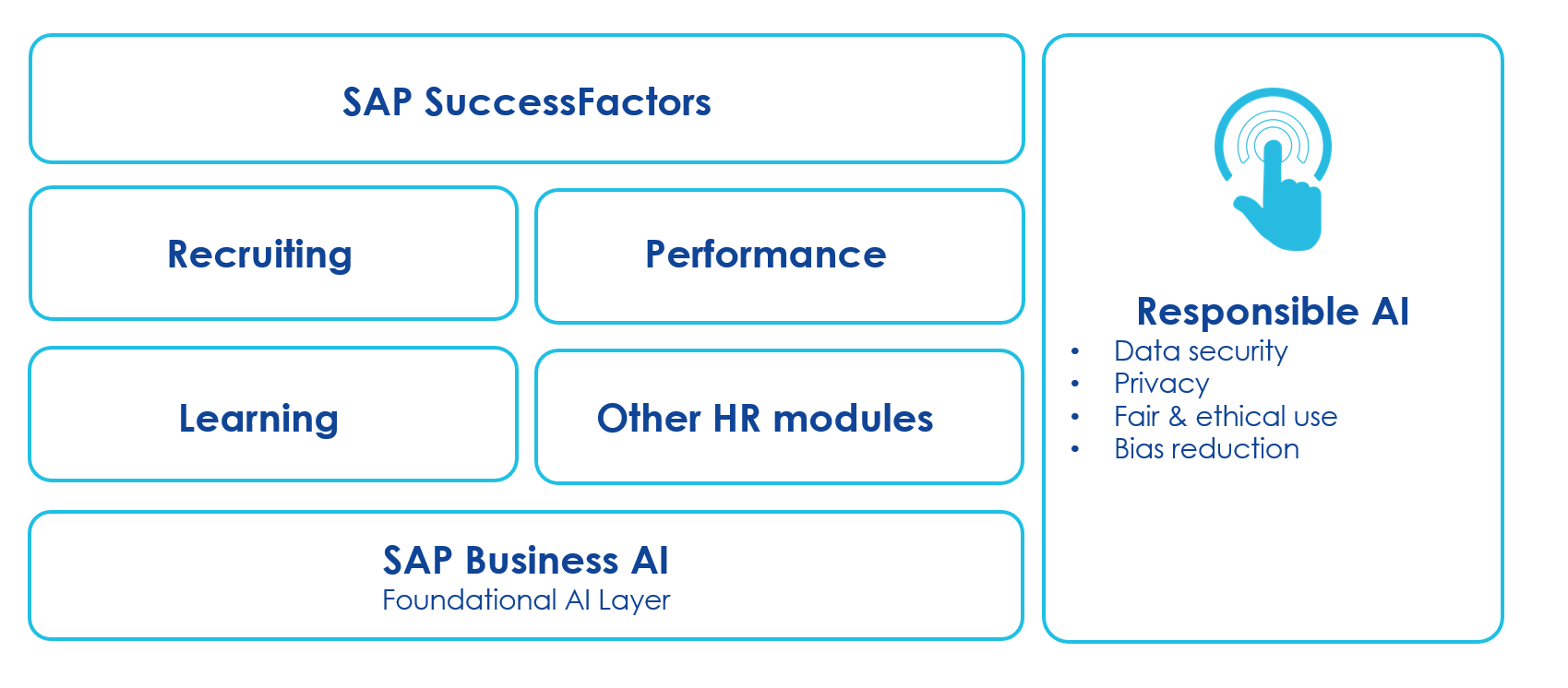
SAP Business AI is SAP’s overall approach to using artificial intelligence across all business applications, including SAP SuccessFactors.
SAP Business AI approach defines where AI is used, how it is embedded in business processes, and how data is protected and administered responsibly.
Within SAP SuccessFactors, AI is tailored specifically to support HR teams, interpreting HR data and complying with established HR workflows.
SAP incorporates the concept of Responsible AI into SAP SuccessFactors.
Responsible AI involves adherence not only to ethical rules and best practices, but also to continuous assessment of fairness, transparency, and accountability in AI development. In practice, this means that AI features are subject to rigorous data protection regulations and operate within SAP's comprehensive enterprise security framework.
SAP also restricts the use of HR data. The company makes sure that this data isn't used to train public AI models. This helps protect sensitive personal information.
According to SAP, Business AI acts as the foundation that enables AI capabilities across SAP SuccessFactors and its modules. With this scheme in mind, let's examine the different types of AI embedded in the platform.
Different types of AI in SAP SuccessFactors
SAP SuccessFactors uses several AI technologies that support each other.
Deep Learning AI
Deep Learning AI in SAP SuccessFactors understands the meaning of HR data. Its main job is to take all the different HR data and turn it into organized, comparable, and predictable information.
In SuccessFactors, deep learning operates across modules such as Recruiting, Learning, Performance & Goals, Career & Succession Planning, Talent Intelligence Hub, and Opportunity Marketplace.
What exactly does deep learning AI do?
-
Understand unstructured data: SuccessFactors contains a lot of text (job descriptions, candidate resumes, employee goals, etc.). Deep Learning models extract skills, competencies, and experience, understand context, and compare different formulations. For instance, "Python programming," "Data analysis in Python," and "Py" here are one skill. This makes it easier to group different skills.
-
Skills inference: AI can make its own assumptions based on data. For example, if a Data Analyst has taken courses in SQL and BI and is working on a project involving analytics, the system can identify missing or hidden skills. This is important for moving between jobs, learning new skills, and getting career advice.
-
Pattern recognition: Deep Learning looks at how people move between jobs, how skills affect performance, and why people leave their jobs.
-
Predictions & recommendations: Based on found patterns, AI supports recommendations both for employees (suitable vacancies within the company, projects in the Opportunity Marketplace, learning courses to fill skill gaps, possible career paths), and for HR and managers (who to include in the succession pool, where there are skill gaps, which teams need upskilling, the risk of employee turnover).
Without this layer, the system would not understand the meaning behind HR data.
Generative AI
Generative AI in SAP SuccessFactors is a layer that utilizes structured HR data, deep learning outputs, and the company's enterprise context to generate content.
Practical examples of Generative AI
-
AI-assisted writing: Generative AI can help employees with their writing tasks. Using language processing capabilities, it understands the context of a sentence and suggests improvements to grammar, spelling, vocabulary, and phrasing. This feature can extend or shorten your text and even transform paragraphs into bulleted lists. It improves readability and ensures a consistent tone.
-
Job description generation: AI processes the information available in a job posting, such as a brief description, a list of required skills or competencies, educational requirements, and so on. Then, it generates a well-crafted description. It does not use information from outside the current job posting on which it is working.
-
Interview question generation: AI can generate behavioural or technical interview questions, using the role, job description, key skills, and competency framework as a basis. It can also vary the difficulty level and recommend follow-up questions.
-
Goal setting: Generative AI can generate a goal based on text entered by the user. This goal includes a name, a description, metrics of success, and all the other fields associated with a goal.
-
Learning and career guidance: AI can analyse personal learning plans, detect skill gaps, draft new career steps, advise on taking a course, and even explain its choice.
As generative AI employs structured HR data as context, its output is consistent with each role and process.
Joule
SAP Joule is an AI copilot that helps users interact with SAP systems using natural language.
Joule understands user intent, uses deep learning to interpret data, and generative AI to create content, and then returns results in a conversational way.
Key features:
-
Dynamic and flexible conversations: You can easily switch between diverse topics or tasks, and Joule won't lose track of your conversation.
-
Context retention: Joule remembers previous conversation context to provide more accurate and relevant responses.
-
Comprehending user intent: Joule recognizes user intents, including multiple entities, pronouns, and possessive adjectives within a single request.
-
Content refinement: Joule can polish content by improving clarity, correcting grammar and spelling errors, adjusting style to fit different needs, and enhancing conciseness.
Note: Joule does not make final decisions, alter data without user confirmation, or operate beyond assigned user permissions. Rather, Joule is designed to log all actions, adhere to governance and compliance standards, and function within a human-in-the-loop framework.
How AI is used across SAP SuccessFactors modules
AI features working across SAP SuccessFactors
This type of AI capability is not limited to a single module. It is built into different HR processes and can be used whenever users interact with the system. This helps improve data and lets different HR processes use the same information.
|
AI capability |
Where it works |
What it does |
|
Assisted writing |
Across SAP SuccessFactors |
Translates HR content directly within the system into 46 languages. Suggests enhancements in grammar, spelling, vocabulary choice, and phrasing. Provide options to change tone. Extends or shortens your text. Converts paragraphs into a bulleted list. Detects biases and suggests replacements. |
|
Assisted Microsoft Teams chat app |
Across SAP SuccessFactors |
Here you can program quick actions for the AI Chatbot. The SAP SuccessFactors App in Microsoft Teams supports Natural Language Processing (NLP), allowing users to trigger quick actions and complete associated tasks by simply typing natural language requests. |
|
SAP Joule (AI copilot) |
Across SAP SuccessFactors |
Acts as a single conversational interface to trigger AI features and retrieve insights across modules. |
AI features limited to specific SAP SuccessFactors modules
This set of AI features is built into specific SAP SuccessFactors modules and supports tasks such as hiring, training, and evaluating employees.
|
AI capability |
Module |
What it does |
|
Interview questions generation |
Recruiting |
Generates interview questions aligned with required skills and role level. |
|
Interview feedback insights |
Recruiting |
Creates interview feedback using AI evaluating a candidate and providing it using Microsoft Teams in SAP SuccessFactors. |
|
Job descriptions enhancement |
Recruiting |
Helps a recruiter or hiring manager enhance a generic job description using generative AI to better reflect their specific hiring needs |
|
Job skills on career site |
Recruiting |
Candidates can now upload their resume and get job recommendations based on the matching of their skills with the job required skills, and see which of the job required skills match the skills found in their resume |
|
Skills validation for job requisitions |
Recruiting |
Recruiters can use AI to extract skills from a job requisition to review and define the essential skills required for the job. They can then refine the list of required skills in the job description to identify candidates whose skills match the job requirements |
|
Skills matching for applicants screening |
Recruiting |
AI assists with skills matching and applicant screening, providing visibility into the applicant's skills and how they match with the skills required for the job |
|
AI-assisted performance insights |
Performance Management |
Managers can gain insights into employees' performance in the latest experience of Performance Management forms. |
|
AI-assisted successor recommendation |
Succession Planning & Career Development |
Succession planners gain insights into the successors that are nominated for a position or an incumbent. |
|
Skills inferencing from continuous management data |
Talent Intelligent Hub |
Recommends skills in the Growth Portfolio based on inputs from the employees in the achievements, activities, or feedback section in Continuous Performance Management, such as achievements, activities, or feedback |
|
AI-assisted person insights for compensation discussions |
Compensation |
Empowers decision-makers with a comprehensive overview that streamlines the compensation-discussion process |
|
Image generation |
Learning |
The AI-assisted image generation tool is an interactive widget that uses generative AI capabilities to assist administrators with images for learning content in Learning Administration |
|
Skills Inference |
Learning |
The feature empowers HR specialists to tag learning items with skills relevant for learners’ requirements, so that they can be discovered more easily |
|
AI-assisted performance goal creation |
Goal Management |
Create personal goals, including performance and development goals, based on an employee’s description of what they want to achieve. |
|
Assignment Creation |
Opportunity Marketplace |
Assignment owners and co-owners can create and edit assignments using generative AI capabilities. |
|
Skills inference |
Opportunity Marketplace |
The feature generates personalized hiring requirements, making the writing more effective and polished, resulting in improved efficiency in matching company talents with assignment needs |
What determines AI availability in SAP SuccessFactors
Although AI is embedded in SAP SuccessFactors, it is not enabled by default and requires licensing in the form of AI Units.
AI Units are a specialized consumption-based units used to access AI capabilities within the SAP Business AI ecosystem.
These units function as virtual credits that can be used to cover the actual usage of advanced AI scenarios, such as generative AI and complex AI-driven insights.
Customers buy SAP AI Units from an SAP account executive. They get a set number of units for a certain period, which can be used for products like SuccessFactors and S/4HANA Cloud. AI Units are spent as AI features are used.
For example, SAP provides Joule with a set number of free messages per year, based on the number of active SuccessFactors users. Once this limit is exceeded, AI Units are consumed. Other premium AI features also require a specific number of AI Units.
Usage of AI Units in SAP SuccessFactors is tracked through the SAP for Me or Business AI dashboards. This helps companies estimate how many Units they use for different tasks and control costs.
Key considerations for implementing AI in SAP SuccessFactors
Integrating AI into SAP SuccessFactors creates new opportunities for boosting recruitment and talent management. However, these features will only deliver real benefits if these key points are considered:
-
Licensing and feature availability: Premium AI features, such as job description generation, automatic skill matching, and AI-assisted interviews, require the purchase of additional AI Units. Before implementation, ensure that the selected features are compatible with your license and budget.
-
Technical preparation and integration: For AI features to work correctly, the relevant SAP SuccessFactors modules should be configured and integrated. For example, the Recruiting Module. You also need to enable and configure the AI capabilities within the system settings.
-
Data quality: AI analyzes existing data on job profiles, employees, and candidate info. To ensure accurate results and recommendations, keep the information up to date.
-
Matching functions to real business tasks: Don't implement all available AI tools at once. First, determine which functions bring the most value to recruiting and HR processes.
-
User training and engagement: AI tools are only as effective as the recruiters and HR teams using them. Conduct training on basic AI usage and show how to accept or adjust AI suggestions. Engage teams in regular feedback on how the system works.
Conclusion
In conclusion, the role of AI in SAP SuccessFactors is to serve as a supportive tool that augments human decision-making and enhances common sense in HR processes involving people, not to make automatic decisions.
The system becomes more useful not because it "thinks," but because it sees the whole picture: skills, experience, goals, and movements within the company. This reduces data chaos and provides a solid foundation for conversations about development, hiring, and careers.
However, the value of AI only becomes apparent when it is used intentionally. AI shows options and highlights opportunities, but the responsibility for interpretation and choice remains with the individual. AI really works for HR as a tool that helps make more data-driven decisions rather than replacing them.
If you want to know more about AI features in SAP SuccessFactors, check out our recent webinar, which is now available on YouTube. In this webinar, our experts provide a practical walkthrough of key AI tools in SAP SuccessFactors, explain how they work in real HR scenarios, and answer common questions from users.
FAQ
Does AI in SAP SuccessFactors make decisions automatically?
AI tools in SuccessFactors don't make final decisions on their own. They help analyze data, generate text options, provide recommendations, or create insights, but key decisions (such as selecting a candidate, approving a goal, or changing a status) always remain with the user.
What is SAP Joule, and how does it work in SuccessFactors?
SAP Joule is SAP's AI co-pilot, which is built into SuccessFactors and other SAP products. It offers a natural language interface for requesting information, navigating the system, and assisting with tasks. Joule works based on the situation and the user's role, helping you work faster and more efficiently.
How can organizations track and manage AI usage in SAP SuccessFactors?
Organizations can track AI usage with monitoring and administration dashboards that show how much AI is being used. SAP also provides reporting tools for purchased AI units, allowing you to control consumption and optimize your budget.
How does SAP ensure AI is used responsibly and securely in HR processes?
SAP develops its AI tools with responsible, secure use in mind. This includes rules about roles and access rights, protecting personal data, and following global AI policies. AI responses are limited to what the user is allowed to see, and data is processed according to company and legal requirements.
Subscribe